Dow 30, Nasdaq 100 and S&P 500: The Crash Continues as Fed Chair Kevin Warsh Sounds Hawkish
 July 30, 2026 · Nitsan
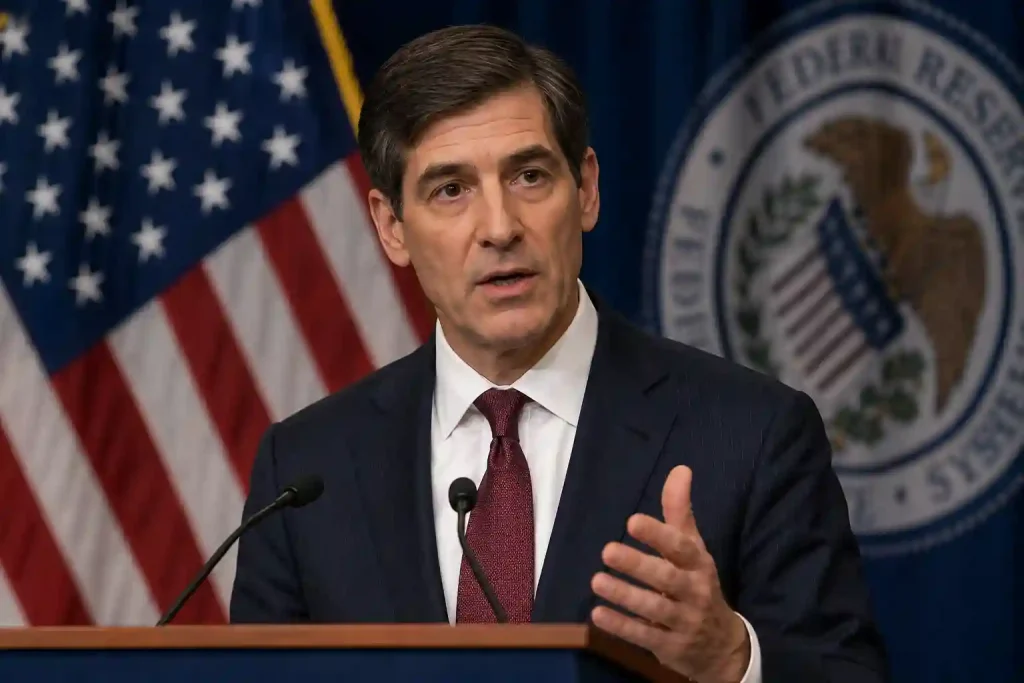
U.S. stock indexes extended their decline as hawkish remarks from Fed Chair Kevin Warsh reinforced expectations of higher interest rates. AI AI-generated illustration
Is the Fed Really Prepared to Watch the Stock Market Continue Falling?
The Federal Reserve left interest rates unchanged, but anyone looking for a reassuring message for the stock market during the press conference probably did not receive one.
Quite the opposite.
Fed Chair Kevin Warsh sounded highly determined to continue the fight against inflation, even at the cost of tighter financial conditions, higher bond yields and additional pressure on stock market indices.
The Fed did not raise interest rates in its latest decision, but the message delivered throughout the speech was clear. The fight against inflation is not over, rate cuts are not guaranteed, and if prices continue to rise, another rate hike remains on the table.
What Was the Fed’s Main Message?
Several highly important statements were made during the speech, and together they created a clear and hawkish picture.
Fed Chair Kevin Warsh said, “This Fed will not waver,” meaning that this Federal Reserve will not back down or change course. He added, “There is no soft inflation target,” meaning that there is no flexible inflation target and that the 2% objective is not open to negotiation. He also stated that if inflation remains high, a rate hike could be part of the solution. He made it clear that the Fed does not intend to look through inflationary shocks and simply say that they do not matter. He said that market prices did not pause during the intermeeting period. He noted that today’s Fed decision is the beginning of the story, not the end of it. He also emphasized, “PCE is our number, and we’re sticking with it.” Finally, he admitted that when it comes to prices, the economy is doing considerably less well.
When all of these statements are put together, the message is difficult to miss.
The Fed is not signaling that easing is near. It is unwilling to compromise on its inflation target, it does not intend to ignore price increases, and it is not ruling out another rate hike if inflation remains persistent.
Why Is This Message Negative for the Stock Market?
Higher interest rates for a longer period increase financing costs for companies and households.
They reduce the attractiveness of investing in risk assets, increase the appeal of bonds and deposits, and lower the present value of future earnings.
As long as the Fed remains committed to restrictive monetary policy, pressure on stock market indices may continue.
The Fed’s message was that it does not intend to rush to rescue the market through interest rate cuts. From its perspective, price stability is more important than reacting immediately to every decline in the indices.
Why Did the Indices Rise During the Speech?
At certain stages of the press conference, stock market indices actually moved higher despite the hawkish tone.
Such a reaction does not necessarily mean that the market interpreted the comments positively.
Sometimes the initial rise is caused by short covering, stop-loss hunting or expectations that the message would be even more severe.
The market often reacts first to the main headline and only later begins to absorb the full meaning of the statements.
Therefore, the fact that the indices rose during the speech does not cancel out the bearish meaning of the message.
What Do We Expect Now for the Dow 30?
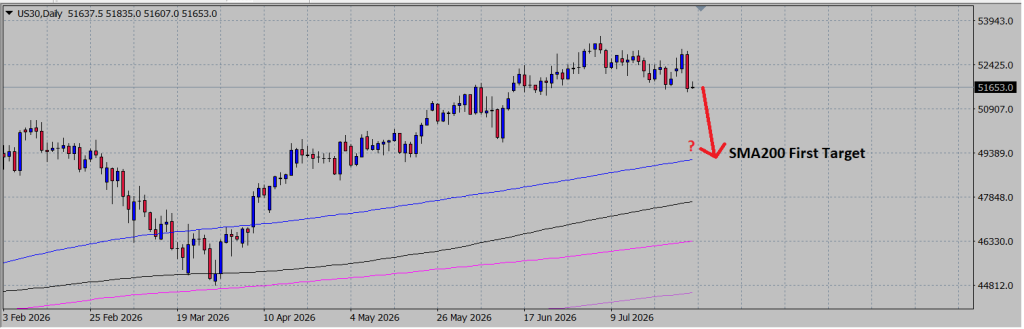
From a technical perspective, we continue to maintain a bearish outlook for the Dow 30.
In our view, the current wave of declines is not yet over.
The attached chart shows that the next major technical target is located near the daily 200-day moving average.
We believe there is a very high probability that the price will continue falling in order to test this area.
The 200-day moving average is considered one of the most important and closely watched levels in the financial markets. When an index trades above it for a long period and then begins a significant decline, the moving average may become a natural target for the price and an important area where buyers are tested.
This does not mean that the decline must happen in a straight line.
Along the way, there may be sharp upward corrections, short covering and brief moves intended to force traders out of the market.
However, as long as the bearish technical structure remains intact and the index fails to recover and hold above the main resistance zones, our outlook remains unchanged.
The Dow 30 is expected to continue falling and test the daily 200-day moving average.
Have We Already Warned About This Scenario?
In our previous articles on both the Dow 30 and the Nasdaq 100, readers can see the bearish scenario that we have identified in the market.
We previously highlighted the resistance areas, the risk of weakness in the indices and the possibility that a more significant wave of declines could develop.
The latest developments in the market, together with the Fed’s hawkish messages, continue to support this scenario.
Although the charts are different, the overall picture is similar.
Momentum is weakening, selling pressure is increasing, and the indices are struggling to resume their upward trend in a stable manner.
Does the Fed Intend to Rescue the Market?
At this stage, the answer does not appear to be positive.
Fed Chair Kevin Warsh made it clear that the central bank does not intend to change course simply because the markets are under pressure.
The Fed is not saying that it wants the indices to crash, but it is also not signaling that a decline in the stock market would cause it to reverse direction quickly.
As long as inflation remains above the target, the Fed prefers to maintain tight financial conditions.
For investors, this means that there is currently no clear safety net beneath the market.
What Is the Bottom Line?
The Fed’s press conference did not provide the reassuring message that many investors had hoped to hear.
The 2% inflation target remains firm. The Fed does not intend to ignore rising prices. PCE remains its main inflation measure. Another rate hike is still possible. The current interest rate decision is not the end of the process.
Therefore, despite the volatility and temporary gains seen during the speech, we believe the pressure on the stock market is not over.
From a technical perspective, the Dow 30 is expected to continue falling and test the daily 200-day moving average.
The crash continues, and for now, the Fed sounds perfectly comfortable with it.
Disclosure: This content reflects the personal opinion of the author only and does not constitute investment advice, a recommendation to take any action or a substitute for professional advice tailored to the individual needs of any person. Trading and investing in financial markets involve significant risk and may result in the partial or total loss of capital. The author may hold positions in the financial products mentioned in this article.