
Intervention in the Japanese Yen: Will the Momentum Continue Until the Open Gap Is Closed?
 September 3, 2026 · Nitsan
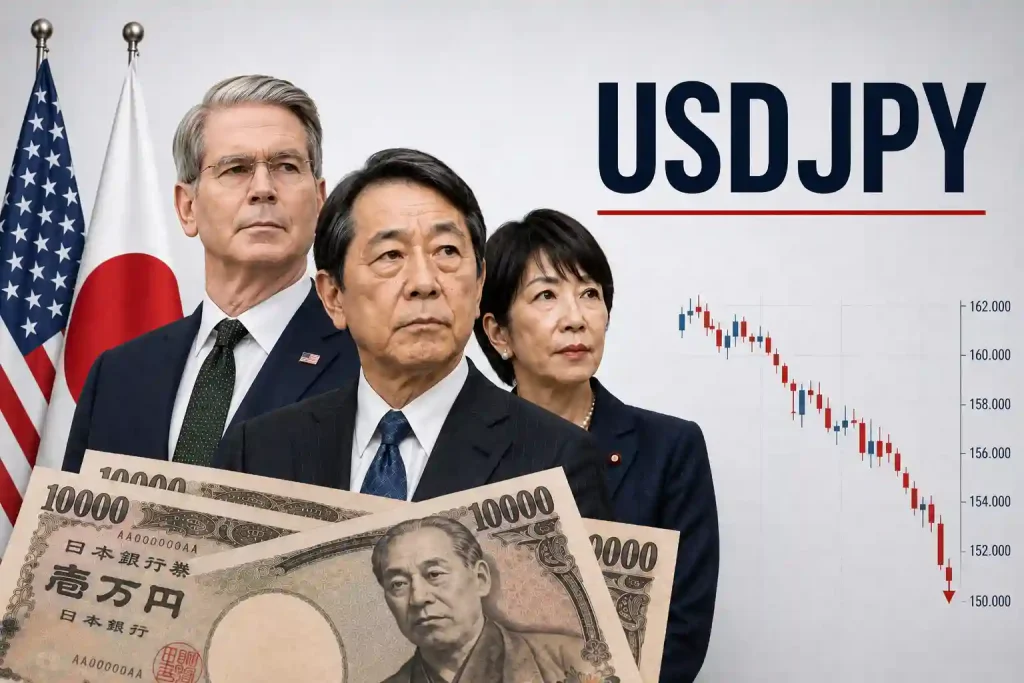
The Japanese Yen continues to gain momentum following intervention, with traders watching whether the move can extend toward the open gap.
What Has Changed in the Japanese Yen Picture?
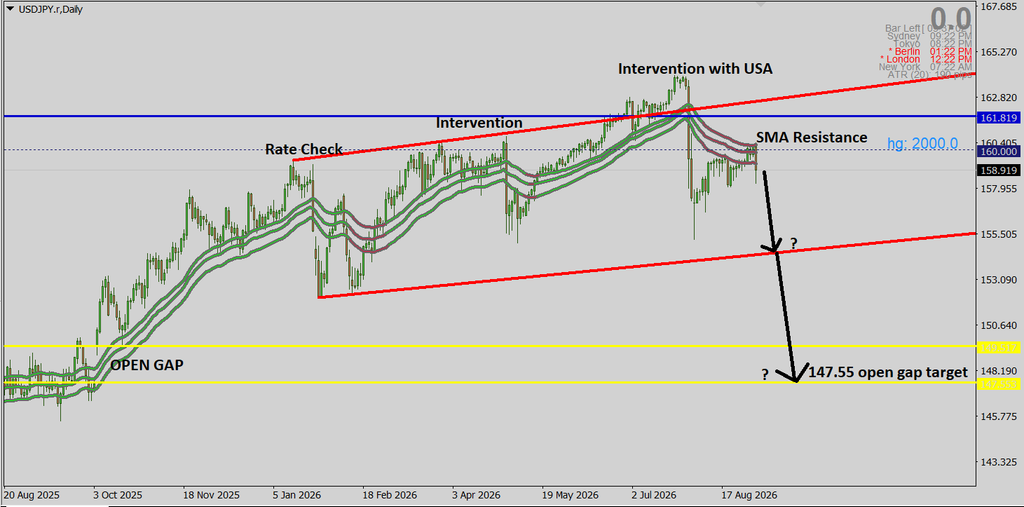
The daily USDJPY chart shows a sequence of events in recent months that has made the higher price area especially sensitive for the Japanese authorities.
First, a Rate Check appeared, a move that is often viewed by the market as a possible warning before intervention. This was followed by an actual intervention, and later, when USDJPY climbed again toward the upper area of the trend line, another significant intervention took place, this time in cooperation with the United States.
From that area, the price fell sharply. After the decline, an upward correction followed, but at this stage the correction has stopped around the moving averages, which in our view have become a significant resistance area.
Are the Moving Averages Signaling the End of the Correction?
After the sharp move lower, USDJPY made a natural correction upward and returned to test the moving average area.
At the moment, the price is struggling to establish itself above this area. From a technical perspective, as long as the moving averages continue to act as resistance and the price does not return to establish an upward trend, we believe there is a possibility of the downward move continuing.
The scenario we are watching is for an initial decline toward the lower trend line marked on the chart.
Is the Trend Line Only an Intermediate Stop?
In our view, yes.
The lower trend line may generate a reaction or a temporary correction, but it is not necessarily the final target of the move.
Below it, there is still a significant open gap around 147.55, with the broader gap area marked on the chart between approximately 147.55 and 149.52.
Therefore, our main scenario is for the decline to continue toward the trend line, followed by an attempt by USDJPY to reach the gap area and close it.
What Are Senior Bank of Japan Officials Saying?
On the monetary side as well, the tone in Japan has become more hawkish.
Bank of Japan board member Hajime Takata said that the central bank should conduct rate hikes in a more nimble and flexible manner and should not be bound by a predetermined pace of increases.
According to Takata, 2026 represents a significant turning point for monetary policy in Japan, and the central bank will need to respond more flexibly to developments in inflation and the economy.
Bank of Japan Governor Kazuo Ueda also indicated that the possibility of a rate hike is already on the table for the upcoming meeting, and that the central bank will reassess at every meeting whether conditions justify further monetary tightening.
From the foreign exchange market’s perspective, expectations for additional rate hikes in Japan may reduce part of the interest rate differential that for years supported selling the yen.
Does the United States Want to See a Stronger Yen?
This may be one of the most important developments in the current picture.
Scott Bessent, the U.S. Treasury Secretary, met with Bank of Japan Governor Kazuo Ueda and publicly spoke about the need for “decisive” monetary measures against yen weakness.
At the same time, Japan and the United States confirmed that they will continue to coordinate with each other on the currency issue.
The significance is that the pressure to strengthen the yen is no longer coming only from within Japan. The United States itself is publicly signaling that it wants to see more significant action from the Japanese central bank against the weakness of the currency.
After we have already seen joint intervention by Japan and the United States around extreme levels in USDJPY, this is a message that the market cannot ignore.
Have the Interventions Changed the Balance of Power?
In our view, yes.
When looking at the chart, a clear sequence can be seen.
First, a Rate Check.
Then an intervention.
Later, the price returned toward the upper part of the trend line.
From there, another significant intervention took place together with the United States.
This was followed by a sharp move lower and then a correction back toward the moving averages.
The key question now is whether the moving average area will indeed mark the end of the correction and open the way for another leg lower.
From our perspective, as long as the price remains below the current resistance area, the scenario of continued yen strength and further declines in USDJPY remains our preferred scenario.
Is USDJPY Heading Toward Closing the Gap at 147.55?
That is our assessment at this stage.
The first target is located around the lower trend line.
If that line breaks, the next technical objective we are watching is the open gap area, with 147.55 marked as the main target.
There is no certainty, of course, that the market will move there in a straight line, and significant corrections may appear along the way. However, the combination of the technical structure, the interventions that have already taken place, the more hawkish tone from the Bank of Japan, and U.S. pressure for a stronger yen supports, in our view, the scenario of further downside.
Important Disclaimer
Trading in capital markets, foreign exchange markets, and leveraged products involves high risk and may result in the loss of part or all of the investment. The content of this article reflects opinion and analysis only and does not constitute investment advice, investment marketing, or a recommendation to carry out any transaction. The author may hold, at the time of publication or afterward, a position in one or more of the assets mentioned.


One Response