Intervention in the Japanese Yen: The First Target Has Been Reached
 September 8, 2026 · Nitsan
Takuji Aida (ai generated)
Has USDJPY Once Again Moved Exactly According to the Scenario We Marked?
In the previous article, we presented a clear scenario for continued strengthening of the Japanese yen and further declines in USDJPY.
We marked that after the latest intervention and the sharp decline, the price completed an upward correction toward the moving averages, and from there we expected the downward move to resume.
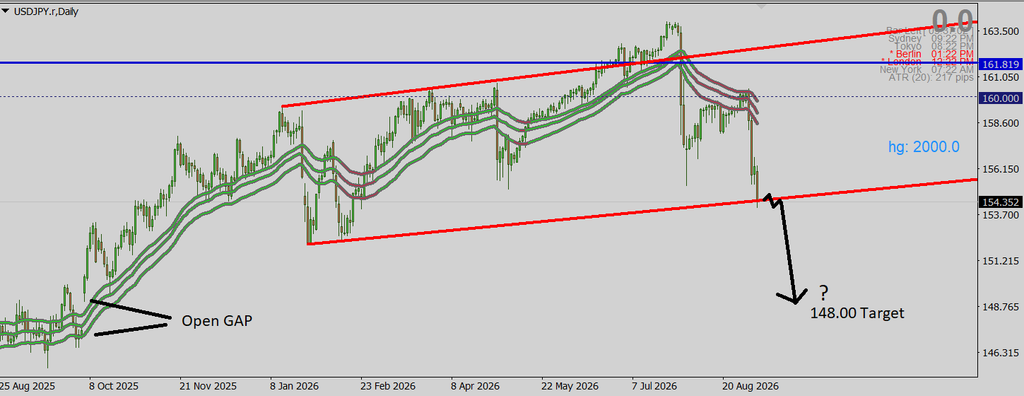
The first target we marked was the lower trend line.
The price has now reached that exact area.
The price reached the level exactly as we expected, once again successfully.
The previous article – Will the Momentum Continue Until the Open Gap Is Closed?
The first stage of the scenario has now been completed, and we are moving to the next stage.
What Do We Expect to See Now?
The first target we marked has already been reached, with USDJPY arriving at the lower trend line exactly according to the scenario we presented.
From here, we expect to see a daily close below the trend line, which in our view would confirm the continuation of the downward move.
After a close below the trend line, our scenario remains clear: continued decline in USDJPY toward the open gap area around 148.
From our perspective, the trend line is the intermediate station that was marked in advance, and the next target remains the closing of the gap.
Does the Next Target Remain the Open Gap Around 148?
Yes.
The open gap around 148 remains our main next target.
Already in the previous article, we marked this area as a possible target after the price reached the trend line.
Now, after the first target has been achieved, the scenario becomes even clearer.
We expect to see a close below the trend line, followed by continued movement lower toward the open gap around 148.
From our perspective, this is a direct continuation of the scenario that was presented in advance.
What Is Behind the Strengthening of the Yen?
The current move is not based only on technical analysis.
On the macroeconomic side as well, there has recently been a significant strengthening of the factors supporting the yen.
The yen has strengthened to levels not seen for months, while market expectations for further interest rate increases by the Bank of Japan have increased again.
At the same time, investors continue to reduce Carry Trade positions, in which the yen has been used as a cheap funding currency.
When expectations are for higher interest rates in Japan, the attractiveness of such trades decreases, and this may continue to support the strengthening of the Japanese currency.
Is the Bank of Japan Moving Closer to Another Rate Hike?
The tone from the Bank of Japan continues to become more hawkish.
Bank of Japan Governor Kazuo Ueda has made it clear that the possibility of a rate hike will be examined at every meeting, including the upcoming meeting.
The main message is that the Bank is not committed to a predetermined pace of rate increases, but will act according to developments in inflation, prices, and the economy.
Bank of Japan board member Hajime Takata also continues to present a hawkish stance.
Takata said there is a need to conduct rate hikes in a more nimble and flexible manner and not be tied to a fixed pace in advance.
He even described 2026 as a significant turning point for Japanese monetary policy.
What Did Senior Japanese Officials Say Today?
Today brought another reinforcement to the scenario of continued yen strength.
Takuji Aida, economic adviser to Japanese Prime Minister Sanae Takaichi, said that he expects the Bank of Japan to raise interest rates as early as September.
His comments are especially significant because in the past he was considered a relatively dovish figure when it came to rate increases.
Aida also expects the Bank of Japan to continue with additional rate hikes at a relatively faster pace, including another increase by January, before later returning to a more gradual pace.
When even figures who were previously more cautious about interest rate increases begin to support monetary tightening, it may reflect a deeper change in Japan’s economic environment and in the approach toward monetary policy.
Are the Japanese Authorities Still Prepared to Intervene in the Market?
Yes.
That message remains very strong.
Japan’s top foreign exchange official, Atsushi Mimura, recently made it clear that the authorities remain on high alert regarding movements in the yen.
He also emphasized that the authorities are not relaxed about the situation in the foreign exchange market and continue to closely monitor sharp moves and unusual volatility.
From the market’s perspective, this means that the threat of another intervention remains in the background.
After the interventions that have already taken place recently, the message from the authorities remains clear: excessive yen weakness continues to receive attention at the highest levels.
What Is the Significance of Cooperation With the United States?
Cooperation between Japan and the United States also remains a central part of the current picture.
Scott Bessent, the U.S. Treasury Secretary, met with Bank of Japan Governor Kazuo Ueda and publicly spoke about the need for “decisive” monetary measures against yen weakness.
In addition, Japan and the United States confirmed that they will continue to coordinate with each other on the currency issue.
The significance is that the pressure for a stronger yen is not coming only from within Japan.
The United States itself is signaling that excessive yen weakness is not desirable and that it supports more significant measures against the weakness of the currency.
After we have already seen joint intervention by the two countries, this remains a highly significant factor in the current picture.
How Significant Was the Latest Intervention?
The latest data show just how aggressively Japan has been willing to act.
Japan’s foreign exchange reserves recorded their largest monthly decline in August, with a major part of that decline connected to intervention in the foreign exchange market.
Japan spent enormous amounts buying yen and selling dollars in an effort to stop the weakening of its currency.
The willingness to deploy resources on such a scale highlights that the authorities do not view yen weakness as a minor issue.
Will a Break Below the Trend Line Open the Way Toward 148?
This is exactly the next stage we expect to see.
The first target has already been reached.
USDJPY reached the lower trend line exactly as we marked in advance.
We now expect a daily close below the trend line, followed by a continued move lower.
Our next target remains the open gap area around 148.
From a technical perspective, this would be a natural continuation of the move that began after the intervention, went through a correction toward the moving averages, and then returned lower exactly toward the first target that had been marked.
As long as the technical structure continues to develop according to the scenario, we continue to expect further yen strength and further declines in USDJPY toward the 148 area.
Important Disclaimer
Trading in capital markets, foreign exchange markets, and leveraged products involves high risk and may result in the loss of part or all of the investment. The content of this article reflects opinion and analysis only and does not constitute investment advice, investment marketing, or a recommendation to carry out any transaction. The author may hold, at the time of publication or afterward, a position in one or more of the assets mentioned.