Trading Software and Brokers: How to Choose Correctly and Avoid Expensive Mistakes
 May 12, 2026 · Nitsan
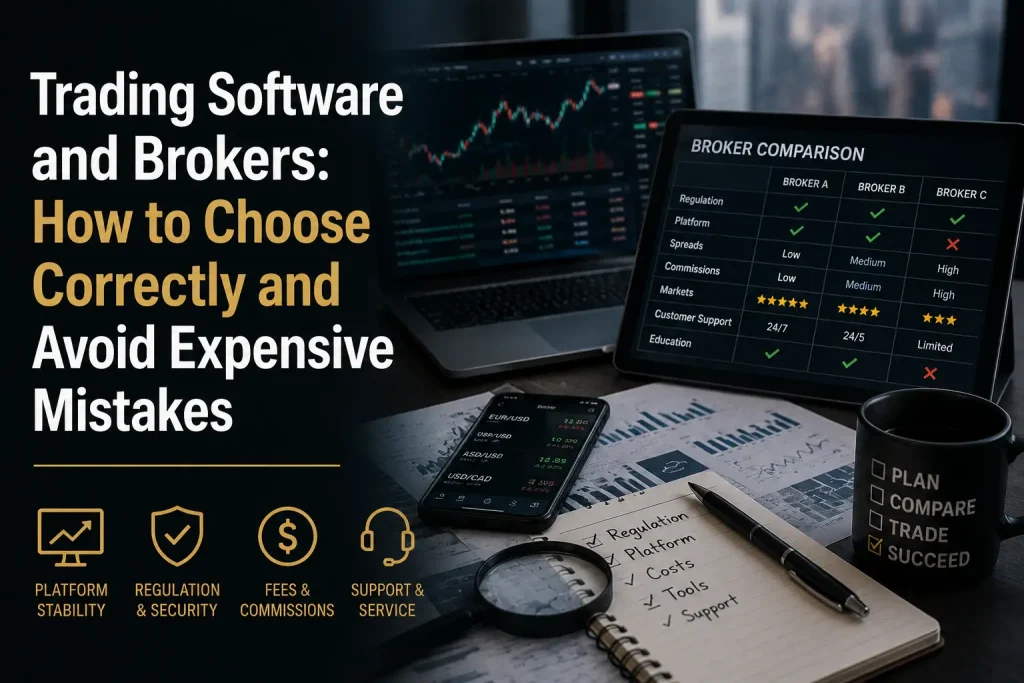
In the modern trading world, choosing a trading platform is one of the most important decisions every trader makes. Beyond strategy, charts, or market understanding, everything ultimately passes through the software where trades are actually executed. That is why it is important to understand what options exist, the advantages of each system, and how to work correctly from the very beginning.
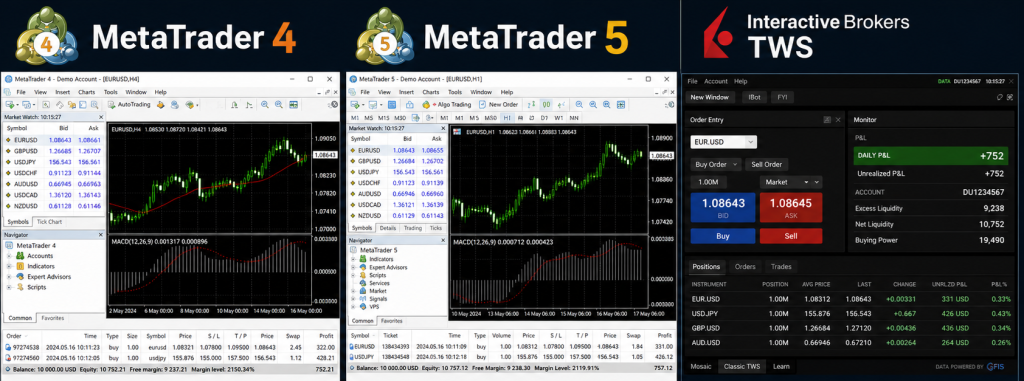
One of the most widely used trading platforms in the world is MetaTrader, in its MetaTrader 4 and MetaTrader 5 versions. These are very established platforms, mainly used for CFD and foreign exchange trading, though not exclusively. Over the years, they have become a standard among many brokers thanks to their relative simplicity, stability, and the wide range of features they offer.
One of MetaTrader’s biggest advantages is the ability to expand the platform using external tools. Traders can build or download scripts and add-ons, sometimes even free of charge, that make it possible to fulfill almost any need not already built into the system. For example, it is possible to create tools that display total open lot exposure in real time, calculate overall exposure, manage positions in advanced ways, or execute automated actions with a single click.
In addition, there are technological differences between MetaTrader 4 and MetaTrader 5. MT5 includes a more modern infrastructure featuring Gateways, APIs, and connections to liquidity providers and exchanges. MT4, on the other hand, often connects to liquidity providers through bridges and external infrastructures linking the trading platform, broker systems, and liquidity providers. This means that not only the platform name matters, but mainly how the broker built the infrastructure behind the scenes.
However, MetaTrader also carries a mixed reputation. Some traders associate it with brokers operating under a B Book model, where the broker acts as the counterparty to the client’s trades. In such situations, a conflict of interest may arise. On the other hand, it is important to understand that the platform itself is only a tool. There are also large and regulated institutional brokers using the same platform in a fair and transparent way. For example, institutions such as Swissquote Bank offer trading through MetaTrader under strict regulation.
The truly important point is not only which platform is being used, but also which broker the account is opened with. Before opening a trading account, it is extremely important to examine the broker’s regulation. Strong regulation can provide a significant layer of protection for client funds. For example, regulation by the FCA in the United Kingdom is considered among the strongest in the world.
Before opening an account, it is not enough to simply check that a broker has regulation. It is important to verify the actual license number on the regulator’s website and confirm that the account is opened under the same regulated entity. There are cases where a broker presents strong regulation, while in practice the client is registered under another entity with weaker protection.
In addition, traders should pay attention to which branch of the broker they are opening the account with. Some brokers operate several legal entities. The same broker may have one branch under British regulation while also operating another branch under weaker regulatory jurisdictions. In such cases, it is usually preferable to choose the branch operating under stronger supervision.
Another important point is the segregation of client funds. Regulated brokers are required to hold client money in accounts separated from the company’s own accounts, reducing risk in the event of financial problems at the broker.
When it comes to trading, it is also important to understand execution conditions. Choosing a convenient platform alone is not enough. Traders should also understand how trades are actually executed. Different models exist such as Market Maker, STP, and ECN. Each has advantages and disadvantages, and the choice affects execution speed, spreads, and reliability.
In addition, attention should be paid to spreads and commissions. Sometimes a broker offers low spreads while charging a separate commission, and sometimes the opposite. It is important to understand the total cost of each trade.
Beyond trading commissions, traders should also examine additional fees such as deposit fees, withdrawal fees, or inactivity fees, which may affect overall profitability over time.
Another critical point that many traders tend to overlook is rollover fees, also known as SWAPS. This is the daily interest charged or received when holding a position open beyond one trading day. It is extremely important to thoroughly examine the broker’s SWAP conditions, since some brokers apply a significant markup to these fees.
In such cases, it is possible that even if a trader enters a correct trade and reaches the target price profitably, rollover fees may consume a large portion of the gains or even turn the trade into a loss. Such situations may push traders into taking shorter-term trades that are not necessarily optimal, simply to avoid paying interest.
Even with fairer brokers, it is important to understand that every currency pair has one side that receives positive interest and another side that pays interest. For example, in USDJPY, a long position may generate positive interest, while a short position may incur rollover charges. Therefore, traders should carefully consider whether to enter a short position in such a pair, especially for long-term trades.
A proper understanding of the SWAP world can also influence the choice of currency pair itself. For example, a trader identifying a short opportunity in USDJPY may consider executing the trade through a pair such as CHFJPY, where short-position interest conditions may sometimes be more favorable. In many cases, these pairs display a certain degree of correlation, and therefore the choice between them can significantly affect the overall outcome of the trade.
In addition, traders should pay attention to the leverage offered by the broker. High leverage allows greater market exposure, but it also significantly increases the risk of losses. Improper use of leverage is one of the main causes of losses in the market.
Execution speed and server response times, also known as latency, can also affect trading results, especially for active or algorithmic traders.
It is important to understand that slippage can be both positive and negative. In other words, a trade may be executed at a better or worse price than requested, depending on market conditions and broker infrastructure.
When it comes to broader global market trading such as stocks, options, futures, and bonds, one of the leading platforms is Trader Workstation by Interactive Brokers. This is a highly advanced system offering direct access to a wide range of exchanges around the world, alongside advanced tools for analysis, risk management, and order execution.
Unlike platforms such as MetaTrader, which are mainly associated with the foreign exchange market, TWS focuses on multi-asset trading and is more suited for advanced traders and investors managing diversified portfolios. The system includes advanced capabilities for position management, options trading, algorithmic trading, and access to global markets on a very large scale.
Another important advantage is that, as of today, Interactive Brokers often offers interest on unused cash balances not allocated to positions. In other words, funds sitting inside the trading account but not invested may generate a certain yield, adding another layer of efficiency to capital management.
However, it is important to note that the system is more complex and requires time to learn, which is why traders at the beginning of their journey may prefer to start with simpler platforms before eventually transitioning to more advanced systems such as TWS.
There are also additional platforms in the market such as cTrader and banking platforms, and every trader should choose the system that best fits their own needs.
One of the most important things for every trader, especially at the beginning, is not to rush. When approaching a new platform or starting to trade, it is preferable to begin with the smallest possible size in order to learn the system and avoid expensive mistakes.
Most brokers offer demo accounts and sometimes also “pepper” accounts. A demo account allows trading with virtual money under real market conditions, while a pepper account displays real prices without risking real money. These are extremely important learning tools.
Every trading platform contains basic concepts that every trader must understand. When traders want to profit from a price increase, they open a buy position, known as a Long or Buy position. When they want to profit from a decline in price, they open a sell position, known as a Short or Sell position.
In addition, there are trading orders such as Take Profit, which closes a trade at a predefined profit level, and Stop Loss, which is intended to limit losses. There are also Limit orders that allow entry into a trade at a predetermined price.
Beyond this, many additional trading platforms exist, and every trader must find the system that suits them. The correct way to begin is to open a demo account, experiment, learn, and ask questions.
Even after transitioning to a real account, it is important to remain cautious, start small, and understand that every small mistake can cost real money.
Ultimately, the trading platform is only a tool. Knowledge, experience, and risk management are what determine the outcome over time.
It is important to emphasize that this article does not constitute a recommendation to use any specific trading platform or open an account with any particular broker.
Every platform and every broker offers different conditions, advantages, and disadvantages, and the appropriate choice depends on each trader’s personal needs, level of experience, and objectives.
Before making any decision, it is recommended to conduct independent research, read the terms of service, understand the risks involved, and practice through a demo account as much as possible.
Disclaimer
This article does not constitute investment advice, financial recommendation, or a substitute for independent judgment. It reflects general information intended for educational purposes only.