
USDJPY Returns Above Key Moving Averages And Approaches Japan’s Intervention Zone Again
 May 18, 2026 · Nitsan

USDJPY Climbs Back Toward The 160 Area
After the latest interventions and the sharp declines seen in the market, USDJPY has managed to climb back above the major moving averages and is once again approaching the 160 area.
From a technical perspective, this is currently one of the most critical zones for the short term price structure.
The USDJPY currency pair continues attracting major attention in the foreign exchange market as the price climbs back above the major moving averages on the daily chart and once again approaches the levels where the latest Japanese government interventions took place.
Japan Already Managed To Create Sharp Declines In The Past
In recent months, Japan’s Ministry of Finance has acted in a particularly aggressive manner in an attempt to stop the weakness of the yen.
The latest interventions successfully created sharp and rapid declines of hundreds of pips, but so far the market has managed to recover a large portion of the move and gradually climb higher again.
Despite the aggressive interventions, USDJPY continues showing relative strength, raising once again the question of whether Japan will choose to intervene again if the price approaches the 160 area.
The Price Returns Above The Moving Averages
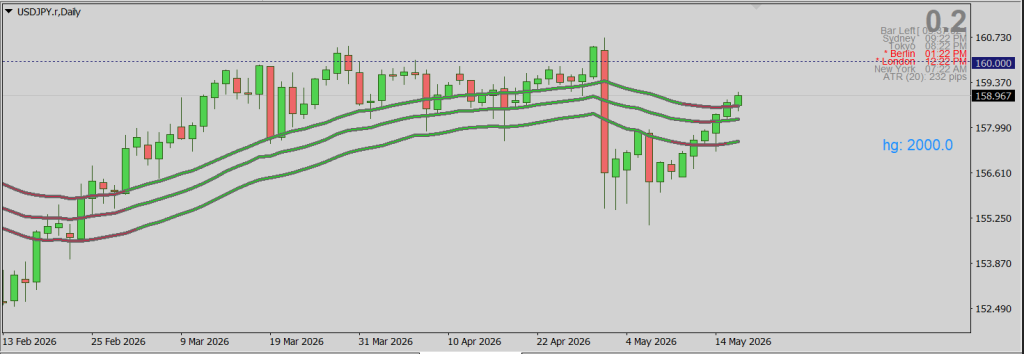
From a technical perspective, the current area is becoming especially critical.
After the declines created by the intervention, the price managed to recover above the major moving averages and is even beginning to rebuild a positive short term structure of higher highs and higher lows.
If the price succeeds in clearly breaking above the 160 area and creating a new high, many traders may view this as a sign that the market is beginning to lose fear of additional Japanese interventions.
On the other hand, as long as the price remains below the previous high, Japan may still attempt to maintain a bearish price structure and prevent another significant breakout to the upside.
Japan Continues Sending Warnings To The Market
In recent weeks, Japan has continued signaling to the market that the possibility of another intervention still exists.
Officials from Japan’s Ministry of Finance repeatedly emphasized that sharp speculative currency movements are undesirable and that authorities are prepared to act if necessary.
In addition, a statement from a senior Japanese Ministry of Finance official recently attracted major attention regarding IMF rules related to foreign exchange intervention.
According to the guidelines, a country may carry out several rounds of intervention while still being considered a fully free floating currency regime.
According to market reports, Japanese authorities reminded markets that three consecutive intervention days are considered a single event under IMF rules, leading traders to interpret that Japan still has legitimacy to conduct additional intervention rounds if necessary.
The United States Also Continues Showing Understanding Toward Japan’s Actions
At the same time, Japanese officials continue emphasizing cooperation with the United States regarding foreign exchange matters.
US Treasury Secretary Scott Bessent stated after meetings with Japanese officials that excessive volatility in the foreign exchange market is undesirable, a comment that markets interpreted as indirect support for the possibility of another Japanese intervention.
Japan’s top foreign exchange diplomat, Atsushi Mimura, also recently stated that there is no real limitation on the frequency of interventions and that Japan remains in continuous communication with the United States regarding the matter.
The Market Is Approaching Another Important Moment
Despite the recent rally, it is important to understand that the risk of extremely sharp volatility remains very high.
Markets clearly remember how the previous interventions managed to create violent red candles within a very short period of time, especially during thin liquidity trading hours when intervention impact can become significantly stronger.
Now the market appears to be approaching another major moment.
If Japan chooses to act again near the current area, we may see another attempt to maintain a bearish price structure and prevent a significant breakout above the 160 zone.
On the other hand, if the market succeeds in stabilizing above these levels and creates a new high, pressure on the Japanese yen may continue increasing in the coming weeks.
Conclusion
USDJPY is now returning to one of the most sensitive areas both technically and psychologically.
The combination of the recovery above the moving averages, the renewed approach toward the 160 area and continued Japanese intervention threats creates a situation where the risk of extremely sharp volatility remains very high.
In our opinion, the current area could become one of the most important decision points for USDJPY in the near future.
It is important to emphasize that this article does not constitute a recommendation to buy, sell or perform any action in the foreign exchange market. This article reflects technical analysis, personal opinion and market interpretation only.
Disclaimer: This article does not constitute investment advice, financial advice or a substitute for independent judgment. The information provided is for educational and informational purposes only. Trading financial markets involves substantial risk of financial loss.


