USDJPY Above 161: Is Japan Approaching Another Intervention?
 July 7, 2026 · Nitsan

The Japanese yen is once again under significant pressure as USDJPY trades above 161, moving beyond the levels that previously triggered one of the largest foreign exchange interventions in Japan’s history.
Earlier this year, Japanese authorities spent an estimated $74 billion to support the yen. The intervention led to a sharp decline in USDJPY, but the effect proved temporary. Within weeks, the pair resumed its upward trend and has now reached fresh highs.
As a result, investors are asking an important question: how long can Japan afford to remain on the sidelines?
Why Is the Yen Still Weak?
Despite the Bank of Japan’s recent interest rate hike, the primary driver behind yen weakness remains unchanged.
The interest rate differential between the United States and Japan is still substantial. As long as U.S. interest rates remain significantly higher, investors are incentivized to engage in carry trades by borrowing yen at low rates and investing in higher-yielding dollar-denominated assets.
This dynamic continues to support demand for the U.S. dollar and maintain pressure on the Japanese yen.
Political Pressure Is Increasing
A weaker yen raises the cost of imported food, energy, and consumer goods, directly affecting Japanese households and increasing concerns about the cost of living.
For this reason, exchange rates are not just an economic issue in Japan. They have become a politically sensitive topic.
The fact that USDJPY has returned to levels above those that previously triggered intervention is raising questions about the effectiveness of Japan’s foreign exchange policy.
The higher the pair climbs, the greater the risk that market participants begin to question the credibility of future intervention threats.
Could 165 Become a Critical Level?
Officially, Japanese authorities do not target a specific exchange rate.
However, many market participants believe the likelihood of intervention increases as USDJPY moves further away from the 160 area and continues to set new highs.
Beyond the exchange rate itself, policymakers must also consider growing public pressure and the need to maintain confidence in their ability to manage currency volatility.
If USDJPY continues to rise toward 165 without any response, many investors may interpret that as a sign of weakening credibility.
The Unfilled Gap Near 148 Remains in Focus
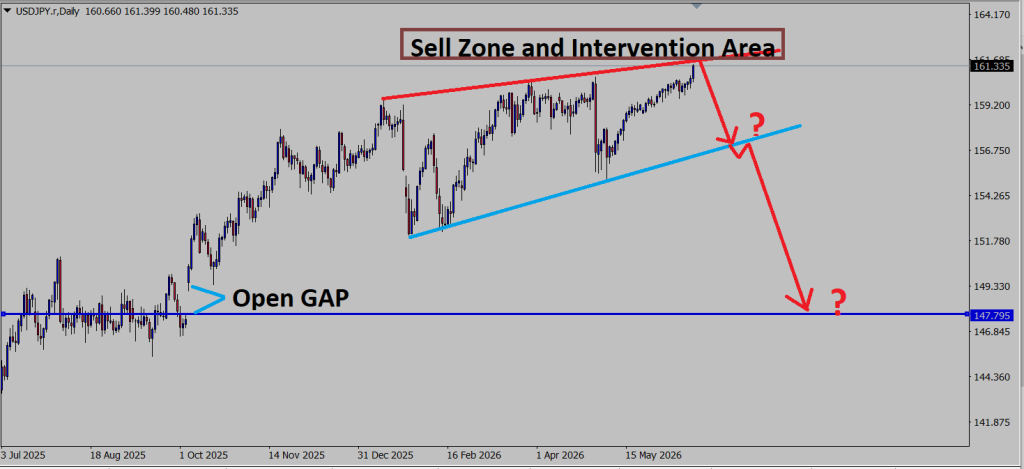
Several months ago, USDJPY closed near 148 on a Friday and reopened close to 150 when trading resumed the following week, leaving behind a gap of approximately 200 pips.
The pair has yet to return and close that gap.
Many traders continue to monitor the 148 to 150 region as a potential long-term target in the event of a significant correction.
Historically, unfilled gaps in major currency pairs have often attracted attention, particularly when supported by broader fundamental catalysts.
What Could Trigger a Sharp Reversal?
Carry trades have been one of the key drivers behind USDJPY’s rally.
However, when these positions begin to unwind, price movements can become rapid and aggressive.
A combination of renewed Japanese intervention, changing U.S. interest rate expectations, and widespread liquidation of leveraged positions could trigger a significant decline in the pair.
In such a scenario, the gap around 148 could become an important technical target.
Outlook
The debate in the market is no longer whether Japan is willing to intervene, but when it may choose to act.
USDJPY is now trading above previous intervention levels, public pressure in Japan is intensifying, and concerns about maintaining policy credibility are growing.
If the current uptrend continues, the probability of another intervention may increase substantially.
As history has shown, when intervention finally arrives, it often comes without warning.
Disclaimer: The information presented in this article reflects personal opinions and market analysis only and should not be considered investment advice, a recommendation, or a substitute for professional financial guidance tailored to an individual’s circumstances.
The foreign exchange market is highly volatile and involves substantial risk, including the potential loss of all invested capital. Market conditions can change rapidly, and forecasts, expectations, and scenarios discussed in this article may not materialize.
Past performance is not indicative of future results. Readers should conduct their own research and carefully assess their financial situation and risk tolerance before making any investment decisions.