
Japanese Yen Intervention: Is The 2026 Market Reaction Too Weak Compared To 70 Billion Dollars?
 May 13, 2026 · Nitsan
Previous Interventions Created Much Sharper Declines
The Japanese yen continues to remain at the center of attention in the foreign exchange market, but this time many traders are beginning to ask a very interesting question.
Is the current market reaction to Japan’s latest interventions too weak compared to the enormous amount of money injected into the market?
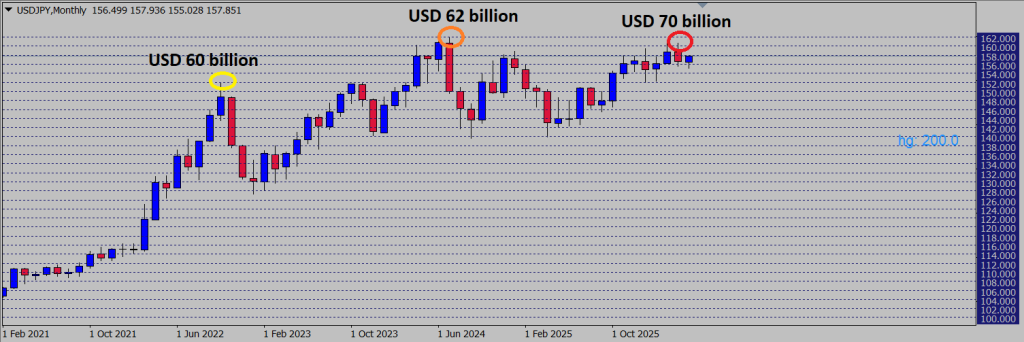
When looking at the monthly USDJPY chart, a very interesting picture can be seen.
In 2022, when Japan carried out an intervention estimated at around 60 billion dollars, the market responded with an extremely aggressive monthly decline.
In 2024, when intervention volumes were estimated around 62 billion dollars, another significant red candle appeared.
In contrast, in 2026, after interventions already estimated around 65 to 70 billion dollars, the market reaction so far appears relatively moderate.
Is The Market Simply Too Strong?
One possibility currently attracting attention among analysts is that the market itself is unusually strong.
A combination of high US interest rates, aggressive carry trades, elevated oil prices and institutional money buying dips has created a situation where Japanese interventions are being absorbed relatively quickly.
In such a scenario, even enormous amounts of money injected into the market fail to create the immediate deep declines seen in previous years.
Or Perhaps, As We Believe, The Real Effect Has Not Arrived Yet?
However, there is another possibility, and it is the one attracting increasing attention among traders in the market.
It is very possible that, as we believe, the real effect of the Japanese interventions has still not arrived yet.
Interventions do not always work in a linear and immediate way.
At first, the market “absorbs” the intervention, the price even manages to recover slightly higher, and many traders begin to think the move failed or that Japanese authorities are unable to stop the momentum.
But precisely at that stage, psychological weakness begins building inside the market.
Leverage starts declining, speculators begin losing confidence, and every additional small trigger could create an extremely aggressive unwind and a much sharper wave of declines than the market currently expects.
Japan’s Goal May Not Be Only To Move The Price
According to several recent Reuters reports, the objective of Japanese authorities may not necessarily be only to sharply push USDJPY lower in the short term.
Part of the goal appears to be breaking the confidence of speculators holding aggressive long USDJPY positions.
Today, the market is already highly aware of the 160 area and the intervention risk.
Unlike previous years, when interventions caught traders more aggressively by surprise, this time almost everyone is already waiting for Japan’s next move.
Such a situation can sometimes create a dangerous sense of confidence, especially after the price managed to recover back toward the 158 area following the latest intervention.
Precisely Now The Market May Be More Vulnerable
But precisely because the market is beginning to calm down, it may actually become more vulnerable.
If another rejection appears near resistance levels, US bond yields change direction or Japan intervenes again, it is very possible that we could see a much larger red candle than the market currently expects.
From a technical perspective, as long as USDJPY struggles to break and hold above the 160 area in a stable manner, the risk of another sharp downside move remains significant.
We Believe A Sharp Move Lower Is Approaching
The purpose of comparing the previous interventions is to demonstrate how the market reacted historically whenever Japan entered the market with large scale intervention.
When looking at historical data, it is difficult to ignore the fact that previous interventions eventually led to much more aggressive downside moves.
For that reason, in our opinion, as long as USDJPY continues trading near the current resistance areas and fails to break sustainably above 160, the probability of a sharp downside move in the near future remains very high.
Conclusion
When comparing the interventions of 2022, 2024 and 2026, it is difficult to ignore the fact that the current market reaction appears relatively weak compared to the amount of money injected into the market.
The major question currently occupying forex traders is whether this is proof that the market is unusually strong, or whether it is simply the calm before a much sharper and more aggressive decline.
It is important to emphasize that this article does not constitute a recommendation to buy, sell or perform any action in the foreign exchange market. The article reflects technical analysis, personal opinion and market interpretation only.
Disclaimer: This article does not constitute investment advice, financial advice or a substitute for independent judgment. The information provided is for educational and informational purposes only.


