USDCAD: Is it on the way to a correction of the recent gains?
 July 8, 2026 · Nitsan
After a strong rally, traders are watching closely to see whether USD/CAD is preparing for a corrective move.
The powerful movement of recent weeks in the leading currency pair shows initial signs of a serious brake. After a prolonged upward move that brought the market to new highs, traders are beginning to identify a change in the balance of power. The combination between the developing technical structure on the charts and the stream of economic data arriving from around the world creates fertile ground for assessments regarding an upcoming turnaround in the short term.
What does the geometric structure of the price tell us?
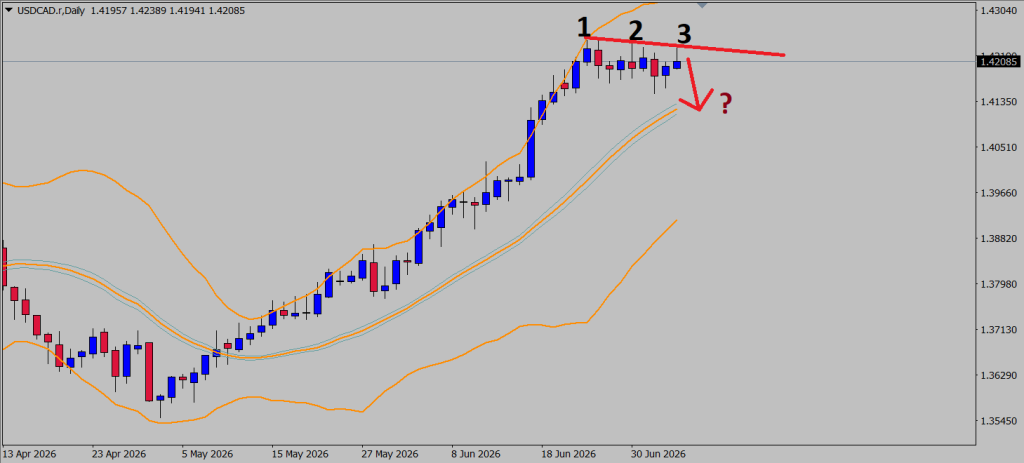
A focused look at the daily chart reveals that the price entered an extreme overextended zone as it kissed the upper Bollinger Band. This touch marked the first turning point, and since then a minor descending trendline has begun to form, connecting the recent peak points. After a retest of the high levels at point one and point two, the price has now arrived at point three. This sequence of candles reflects a clear exhaustion of the buyers, and from point three, a significant downward movement could materialize, whose immediate objective is a retest of the middle line of the Bollinger Band.
How do the employment data from the United States affect?
The general strengthening of the American currency relied in recent months on the assumption that monetary policy would remain tight. However, the recent employment data published in the United States presented a softer-than-expected picture, which led to an immediate wave of profit-taking in the global forex markets. This cooling in demand for the dollar opens a window of opportunity for the parallel currencies, spearheaded by the Canadian dollar, to exploit the temporary weakness of the greenback.
Will a calming in energy prices change the picture?
The Canadian dollar is traditionally and routinely affected by fluctuations in the global energy market. The spike in crude oil prices during the months of May and June, which stemmed mainly from geopolitical concerns, pushed inflation expectations in Canada upward. Now, following the achievement of interim political agreements and the calming of tensions, oil prices have returned to more balanced levels, something that removes the immediate pressure from the Bank of Canada to act aggressively and stabilizes the status of the local currency.
Where is the market headed in the coming days?
The combination between the distinct technical braking at point three and the change in fundamental sentiment increases the probability of a liquidation in the immediate term. If the near support levels are broken, the way to the middle line of the Bollinger will be paved, something that will give the Canadian dollar an additional push. Traders will closely follow the publication of the Purchasing Managers’ Index (PMI) data in the United States and the wage data in Canada later this week to receive a final confirmation for the strength of the brewing move.
Disclaimer: Trading in the capital market and foreign exchange in particular involves high financial risk and is not suitable for every person. Everything stated in this article represents the personal opinion of the writer only and does not constitute a recommendation, investment advice, or a substitute for independent judgment. The writer may hold open positions (long or short) in the assets mentioned in this article or in financial products derived from them, and this without prior notice.